

-
Products
-
Loudspeakers
- Atlas+Fyne IsoFlare™ Loudspeakers
- SHS Series
- In-Ceiling
- Surface Mount
- Pendent Mount Speakers
- IP Speakers
- Sound Masking Speakers
- Subwoofers
- Line Columns & Arrays
-
Speaker Components
- Speaker Drivers
- Transformers
-
Baffles & Back Boxes
- Blind Mount Enclosures
- EZ Mount Enclosures
- General Purpose Baffles
- Vandal Proof
- Q series
- Q Series - Square
- Recessed
- Torsion Baffles & Enclosures
- Cylindrical
- General Purpose Baffles - Square
- Recessed - Square
- Surface Mount Enclosures - Square
- Fire Rated
- 8" Speaker & Analog Clock
- Surface Mount Enclosures
- Mounting Rails
- Mounting Rings & Squares
- T Bar Bridge
- Portable Speakers
- Specialty Speakers
- Life Safety
- Horns
- Sound Masking
- Amplifiers
- GLOBALCOM® Enterprise Communication Ecosystem
- 5400 Series Life Safety Public Address System
- IP Solutions
- DSP / Signal Processors
- AC Power Distribution
- Racks and Cabinets
- Microphone & Mic Stands
- Audio Accessories & Options
- Dante® Enabled Devices
- Buy America Act - Trade Agreements Act
- Discontinued Product
-
Loudspeakers
- Systems
- Markets
- Support
- Resources
- About Us
-
Products
-
Loudspeakers
- Atlas+Fyne IsoFlare™ Loudspeakers
- SHS Series
- In-Ceiling
- Surface Mount
- Pendent Mount Speakers
- IP Speakers
- Sound Masking Speakers
- Subwoofers
- Line Columns & Arrays
-
Speaker Components
- Speaker Drivers
- Transformers
-
Baffles & Back Boxes
- Blind Mount Enclosures
- EZ Mount Enclosures
- General Purpose Baffles
- Vandal Proof
- Q series
- Q Series - Square
- Recessed
- Torsion Baffles & Enclosures
- Cylindrical
- General Purpose Baffles - Square
- Recessed - Square
- Surface Mount Enclosures - Square
- Fire Rated
- 8" Speaker & Analog Clock
- Surface Mount Enclosures
- Mounting Rails
- Mounting Rings & Squares
- T Bar Bridge
- Portable Speakers
- Specialty Speakers
- Life Safety
- Horns
- Sound Masking
- Amplifiers
- GLOBALCOM® Enterprise Communication Ecosystem
- 5400 Series Life Safety Public Address System
- IP Solutions
- DSP / Signal Processors
- AC Power Distribution
- Racks and Cabinets
- Microphone & Mic Stands
- Audio Accessories & Options
- Dante® Enabled Devices
- Buy America Act - Trade Agreements Act
- Discontinued Product
-
Loudspeakers
- Systems
- Markets
- Support
- Resources
- About Us
- HOME /
- Resources /
- Installations & Case Studies /
- wsu-case-study
WICHITA STATE UNIVERSITY Case Study
Wichita State Students Get Hands-On Experience Working With AtlasIED’s IPX Endpoints
Wichita State University is a public research university located in Wichita, Kansas, serving approximately 18,000 students. Innovation is a core tenet of the university, which is why 10 years ago it launched a major academic and student life initiative, dubbed the "Innovation Campus." The plan included public/private partnerships with domestic and international companies that would collaborate with the students and faculty on research projects and product development through a technology transfer system.
Central to the Innovation Campus is the Project Innovation Hub, which fosters an experiential learning and innovation mindset, promoting interdisciplinary collaborations across all Colleges and within the WSU community. From Freshman year through graduation, they provides a dynamic space for students, researchers, and industry professionals to ideate, create, and explore together. This initiative brings together a diverse group of students from various disciplines, including biomedical, aerospace, computer science, and electrical engineering, under the guidance of faculty and industry mentors.
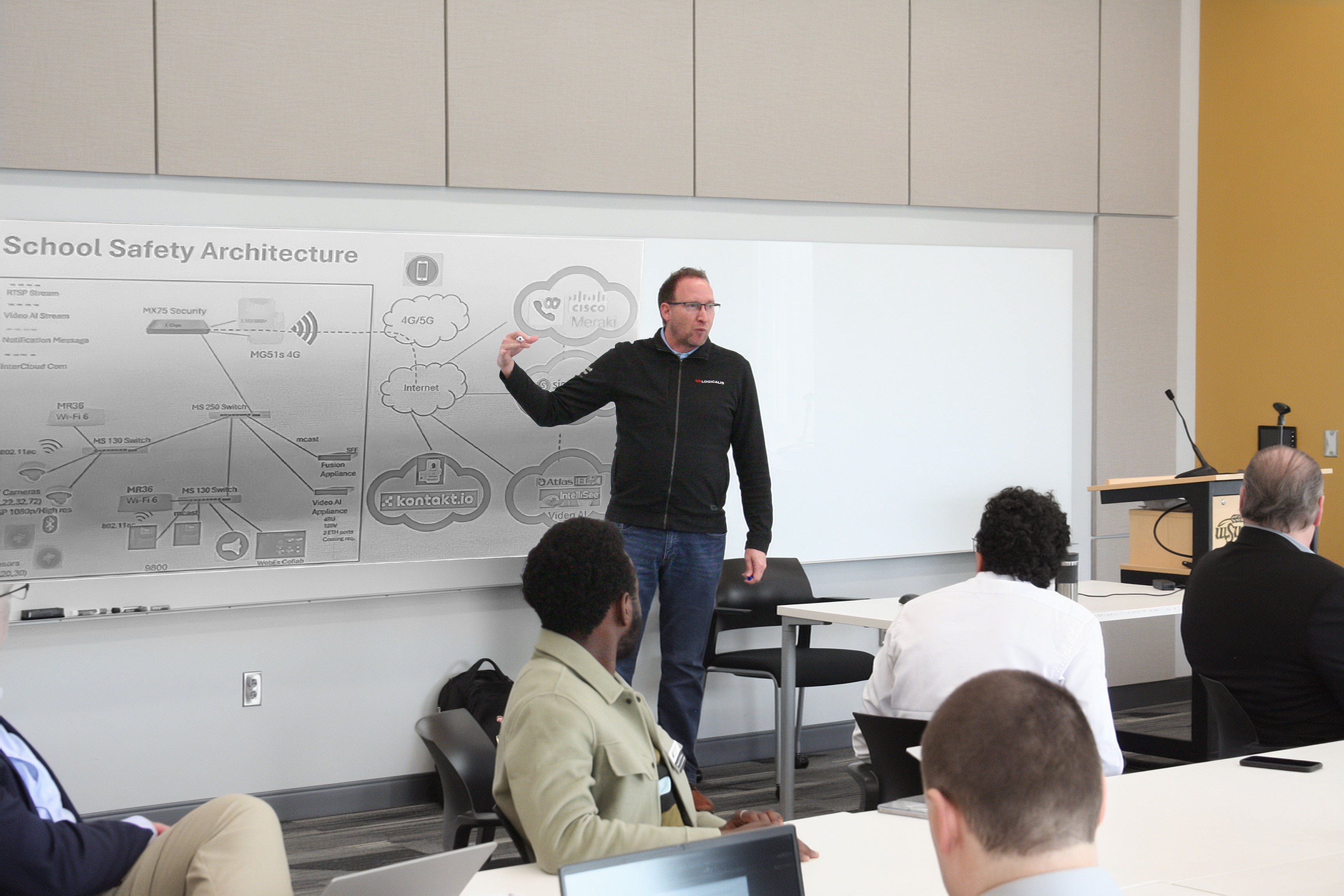
"Recently, one project that students championed involved designing, testing, and implementing a campus-wide security system in a laboratory environment using equipment from several leading vendors in their respective industries. Key partners, including AtlasIED, Cisco, Singlewire, IntelliSee, Kontakt.io, and Logicalis, supported the installation and integration efforts. The project’s interdisciplinary approach leverages the students’ varied backgrounds, allowing each to contribute their unique perspective."
“This project started like most anything does, with an innocent conversation that began asking ‘what if?’ questions or ‘I wish I could do X,’” said Nathan Smith, Director of the Project Innovation Hub at Wichita State. “It was some industry connections and I that started talking about common problems that can be addressed, and it snowballed from there into a full project. Our backdrop was the school security safety concerns raised by various stakeholders within the regional school districts.
Director of the Project Innovation Hub at WSU
“For the manufacturers, the project deliverable was to fill in the gaps. They wanted us to develop a more standard or preferred way to interconnect the systems, fill in the gaps in documentation, and validate that the systems can actually work together.”
“For the students, part of it was having them directly interface with industrypersonnel,” said Smith. “I initiated some conversations, but after a while, Istepped back and had the students contact the SMEs themselves to get theirtechnical questions answered. I wanted them to learn how to communicatedirectly and understand the different stakeholders.
“Another thing that is rare for students is the ability to essentially complete the entire reference architecture themselves. There was limited documentation for integrating Vendor A with Vendor B. And I think that was probably one of the best learning cases for students, because you really never get that. In a course, you have to pre-define everything, challenge them, but you have to know the output yourself. And when we go into something like this, I don't even know what the output is, I'm right there with them, figuring it out.”
The project leveraged AtlasIED’s IPX Series of IP endpoints, which students used to test integrations and manage communications across campus spaces. They are designed for modern facilities (schools, healthcare, manufacturing, corporate campuses) that want a unified, network-based solution for AV communication and alerts - combining day‑to‑day announcements with emergency messaging, using the same hardware. The IPX Series comprises IP loudspeakers, IP visual displays and flashers, IP-to-analog gateways (supporting legacy systems), and extension components.
Alex Puorro, Vice President of IP Endpoint Technology at AtlasIED, played a pivotal role during the project. “When I realized this would be a hands-onlearning experience for the students - allowing them to explore the products, provide feedback, ask questions, and test everything - I got pretty excited. Once we committed to sending the products, my focus shifted to ensuring everything would work seamlessly upon arrival at Wichita State. This involved coordinating with Logicalis, the reseller, and the integrator, while collaborating with Singlewire and IntelliSee to confirm functionality, plan any necessary preparation, and determine which products were most relevant. By reviewing use cases with the students, we could tailor the experience to their needs and ensure the right products were included.”
Students manage the project from start to finish, with faculty and mentors serving as facilitators rather than traditional instructors. Weekly milestones are established, and students work together to achieve these goals. Mentors provide support in troubleshooting, documentation, and technical communication, while students participate in hands-on activities such as system configuration, running tests, and coordinating with team members.
Vice President of IP Endpoint Technology at AtlasIED
The hands-on approach of the project contrasts sharply with traditional lectures. One student emphasized that theoretical classes often fail to provide practical experience: “With lectures, you usually don’t have any hands-on experience. Having these projects is a significant advantage. You physically understand how the network works and how to troubleshoot it.” Students discovered that overcoming repeated challenges left lasting impressions, often teaching lessons more effectively than textbooks ever could. Beyond technical skills, the project fostered independence, problem-solving, and character development, giving students a sense of ownership over their work.
The Wichita State project highlights the significance of hands-on, student-led learning in higher education. By integrating technical skill development, realworld problem-solving, and interdisciplinary collaboration, students gain a comprehensive understanding of the technologies and systems they work with. This initiative serves as a model for how applied projects can effectively prepare students for careers in engineering, technology, and systems management, while also making meaningful contributions to the community.
“One of the best things about this project is that it helped some of the students to get jobs in our industry and defense programs, networking lab, and a few other labs,” said Smith. “This was a year-long research project, so it's got a specific duration, no guarantee of a follow-up, but the skills that they learned help them get hired into permanent internships. From an instructor’s perspective, you can’t ask for a better outcome than that.”